 Book now
 Inside Drottningholm: State Rooms & Chinese Pavilion
A room-by-room guide to Drottningholm's Baroque staircase, gilded state apartments, garden sculpture and the Rococo fantasy of the Chinese Pavilion.
Drottningholm rewards visitors who know where to look. This is a walk through its finest interiors and gardens, from the Tessin staircase to the Rococo Chinese Pavilion, so you arrive knowing what makes each room remarkable.
The grand Baroque staircase
Almost every visit begins at the staircase, and it is meant to. When Nicodemus Tessin the Elder designed Drottningholm for the Queen Dowager Hedvig Eleonora from 1662, he made the staircase the palace's opening statement — and it became the most extravagant and expensive he ever created. Painting, stucco and sculpture combine as you climb, so that the ascent itself feels staged, each turn revealing a new view back down into the hall. Look for Polyhymnia, the Muse of sacred hymns, among its decoration. This was Baroque theatre in architecture, borrowed from the great palaces of France and Italy that the Tessins knew well and adapted to a Swedish royal setting, in a decade when Sweden had become one of Europe's great powers. Take a moment here rather than hurrying on. The staircase sets the visual grammar for everything that follows — the interplay of painting and sculpture, of gilding and stone — and it announces Hedvig Eleonora's ambition at the threshold: a residence that could stand comparison with the grandest courts of Europe. Look up before you climb, and look back down once you reach the landing.
Karl XI's Gallery
Beyond the staircase lies one of the palace's most eloquent Baroque rooms: Karl XI's Gallery, completed in the time of Nicodemus Tessin the Younger, who took over the building after his father's death in 1682. Karl XI was Hedvig Eleonora's son — still a small child when his father, Karl X Gustav, died in 1660, with his mother leading the regency — and the gallery celebrates his reign as a warrior king, its walls given over to large paintings of his battles. The gallery form itself was a European fashion of the age: a long, light-filled room for walking, conversation and the display of art. Here the decoration is programmed to tell a story of reign and campaign, a painted argument for the young king's place in Sweden's age of greatness. Stand at one end and look down the room; the rhythm of window, pier and painting pulls your eye toward the far wall, exactly as intended. It also helps to remember the family story beneath the splendour. The palace was a mother's project, and this gallery is, in part, a mother's tribute to the son she had raised to rule.
Hedvig Eleonora's State Bedchamber and the apartments
If one room concentrates the palace's opulence, it is Queen Hedvig Eleonora's State Bedchamber. In the Baroque court a state bedchamber was rarely a private place to sleep; it was a ceremonial stage, the most richly decorated room in the residence, where the ruler received chosen guests amid a display of wealth calibrated to overwhelm. Drottningholm's is among the most lavish surviving interiors of its kind in Sweden, and it was worked and reworked over years to reach its present splendour. Everything here is intended to catch and hold light: gilding, deep colour, sculpted ornament and sumptuous textiles combine into a single glowing whole. The ceiling and walls carry an integrated decorative scheme, and the craftsmanship rewards close attention, from carved detail to the fall of rich fabric around the bed. It is a room to read slowly, noticing how each element answers another, the whole assembled to project the majesty of the queen who commissioned it. The bedchamber does not stand alone. It anchors a sequence of state apartments arranged as a Baroque enfilade, rooms opening one into the next along a shared axis so that doorways align into a receding vista. Moving through them, you follow the same graduated approach a courtier once did, from more public spaces toward the most privileged and ornate. Along the way the decoration shifts in tone and date, and the later Rococo taste appears too, lighter, more playful, a counterpoint to the heavier Baroque grandeur of the earliest rooms. The library is part of this world of refined court interiors, a reminder that the palace was a place of learning and Enlightenment conversation as well as ceremony. Together the apartments show Drottningholm as a living royal residence shaped across generations rather than a single frozen moment, each queen and each era leaving its mark on the rooms.
The Baroque garden and the English park
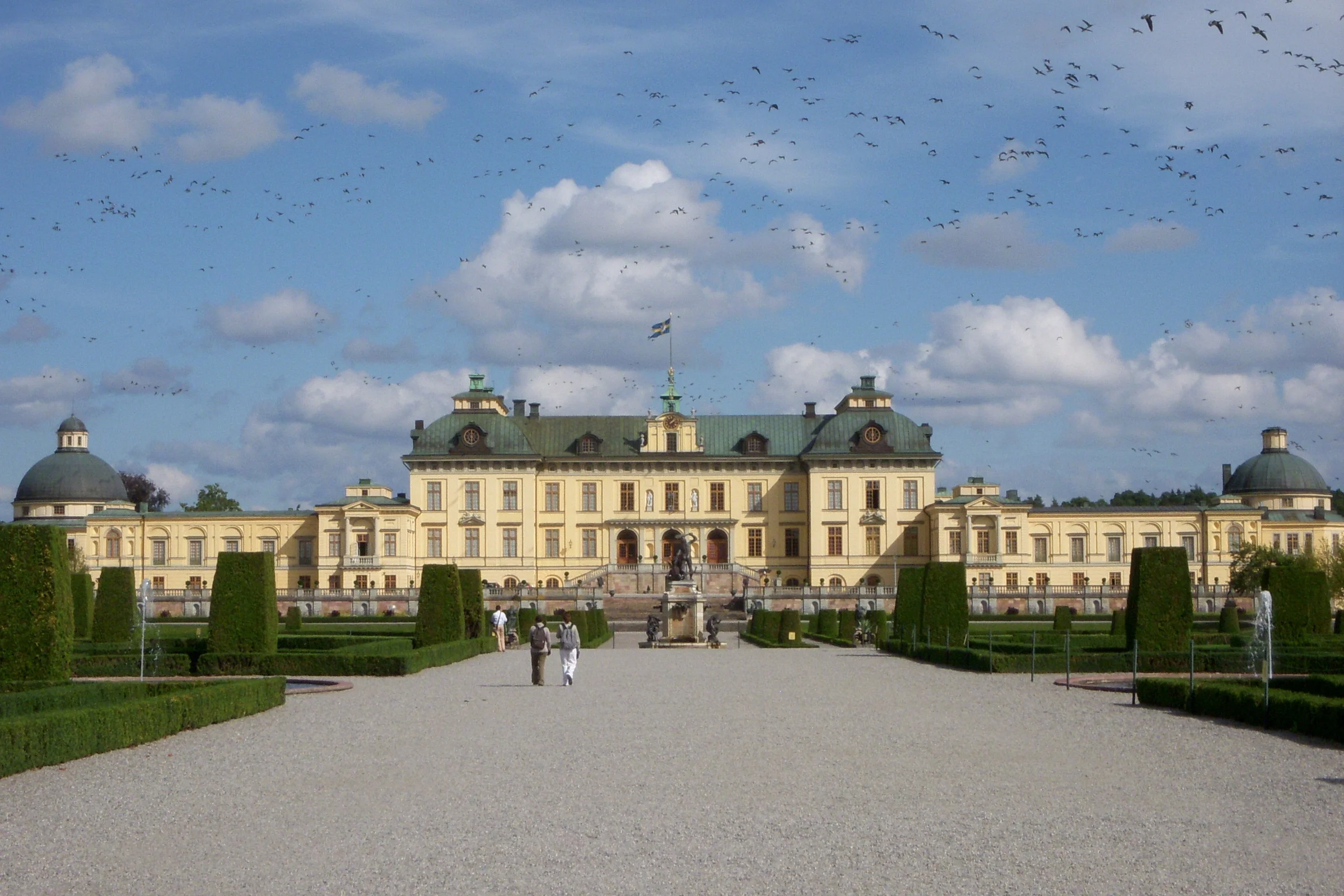
Step outside and the palace's story continues in the grounds, which are free to walk and reward as much time as you can give them. The gardens fall into two contrasting halves, and the contrast is the point. Directly behind the palace lies the formal Baroque garden, laid out in the geometric French manner: clipped parterres, straight avenues, and an axis that extends the architecture of the building out into the landscape. Everything is ordered and symmetrical, nature disciplined into pattern, exactly the ideal of the age that built the state rooms. Fountains and sculpture punctuate this formal zone, with bronze figures set as focal points where paths meet, so that a walk becomes a sequence of composed views rather than a wander. Beyond the formal parterres the mood changes entirely. Here the grounds open into an English landscape park, a later fashion that rejected straight lines in favour of the appearance of unimproved nature: winding paths, irregular plantings, ponds and canals, and carefully placed trees that frame the palace and pavilions from shifting angles. Sculpture appears here too, but sited to be discovered rather than displayed on axis, a statue glimpsed across water or at the turn of a path. Walking from one garden into the other is a lesson in changing European taste, from the controlling Baroque vision to the Romantic one that valued the natural and the picturesque. Because the park is open and free, it also makes the visit flexible. You can arrive early or linger late around your palace visit, using the grounds to bracket your indoor visit, and on a fine day the lawns and waterside make an ideal place to pause between the palace and the pavilion. The sculpture rewards a slow eye; many pieces are set precisely where a particular view of the palace or the lake opens up.
The Chinese Pavilion, a European dream of China
Set apart in the park stands the visit's most beguiling surprise: the Chinese Pavilion, or Kina slott, a Rococo pleasure palace built in the 1760s at the height of Europe's fascination with all things Chinese. It replaced an earlier wooden pavilion that had been given as a royal birthday gift, and it is best understood not as a piece of China but as an eighteenth-century European fantasy of it. Chinoiserie, the ornamental style it embodies, took motifs half-remembered and half-invented from imported porcelain, lacquer and silk and reassembled them into something wholly of its own time and place, playful, luxurious and unmistakably Rococo. The building itself sets the tone, its curving forms and delicate colours a deliberate escape from the formal grandeur of the main palace. Inside, the pavilion unfolds as a suite of intimate, exquisitely decorated rooms filled with the exotic taste of the court at leisure: lacquered panels, painted decoration, and objects gathered or made to evoke a distant, imagined East. This was a place of retreat and pleasure, a setting for a queen and her circle to step out of ceremony into fantasy, and that lightness still defines the experience of visiting it. One practical point matters when you plan. The Chinese Pavilion is seasonal, opening only in the warmer months, so it is not always part of a Drottningholm visit. When it is open, a combined ticket lets you pair it with the main palace and see both the Baroque and Rococo faces of the estate in a single trip; if you are visiting outside the warmer season, expect to enjoy the exterior and its garden setting rather than the interiors. If the Pavilion is open when you come, give it unhurried time. After the weight and gilding of the state rooms, its delicacy is a genuine change of key, and it completes the picture of a court that could be both magnificent and, in its private moments, wonderfully whimsical.
The Court Theatre, a separate sight worth knowing
One more building on the estate deserves a paragraph, though it is not part of a palace ticket and is worth understanding clearly before you come. The Drottningholm Court Theatre, the Slottsteater, is one of the most remarkable eighteenth-century theatres anywhere in the world, and its distinction is not merely that it survives but that it still works. Built in the 1760s, it retains its original stage machinery, the hand-operated wooden mechanisms of ropes, drums and painted flats that let scenery change in seconds and conjure waves, clouds and sudden transformations. Very few theatres of the period kept this equipment; fewer still keep it in working order. To stand in the auditorium is to see how theatrical illusion was made two and a half centuries ago, and the building preserves the atmosphere of a court playhouse with uncommon completeness. It is important to be clear about how a visit works. The Court Theatre is run by a separate organisation, with its own guided tours and its own tickets sold through its own channels, and it is not included in admission to the palace or the Chinese Pavilion. We do not sell or arrange theatre tickets, and we would rather tell you plainly than let you arrive expecting otherwise. Treat it as a distinct experience to plan alongside your palace visit if the machinery and the history appeal to you, and check its own schedule directly, since opening arrangements and tour times follow their own calendar. Practically, the theatre sits within the same estate, so it is easy to combine into a day at Drottningholm even though the tickets are separate. Many visitors pair a palace visit with a walk in the free park and, if it suits them, a theatre tour arranged on its own, building a full day from three complementary experiences. Knowing in advance that the theatre stands apart simply lets you plan the day accurately and avoid disappointment at the door.
Frequently asked
What are the must-see rooms inside Drottningholm Palace?
Start with the grand Baroque staircase, then Karl XI's Gallery and Queen Hedvig Eleonora's opulent State Bedchamber, the palace's richest interior. Continue through the state apartments and the library, which trace the shift from heavy Baroque grandeur to lighter Rococo taste across several generations of royal decoration.
Is the Chinese Pavilion included, and can I always visit it?
The Chinese Pavilion is seasonal, opening only in the warmer months, so it is not always available. When it is open, a combined Palace and Chinese Pavilion ticket lets you see both in one trip. Outside the warmer season you can still enjoy its exterior and garden setting within the free park.
Can I visit the Court Theatre with my palace ticket?
No. The Drottningholm Court Theatre is run by a separate organisation with its own guided tours and tickets, and it is not included in palace or Chinese Pavilion admission. We do not sell theatre tickets. It sits on the same estate, so you can plan a tour there alongside your palace visit by booking through its own channels.
Do I need to book a specific entry time for the palace?
No. Your ticket is valid for one visit at any time during opening hours on your chosen date, so you can take your time in each room. Your e-ticket arrives by email, on mobile or as a print-at-home document.
Are the gardens worth time, and do they cost extra?
The Baroque garden, the English landscape park and the grounds are free to walk, and they are well worth building into your day. The formal parterres and the naturalistic park offer a striking contrast, both dotted with sculpture. Arriving a little early or lingering after your palace visit lets you enjoy them without rushing.