 Book now
 Drottningholm: History of a Royal Residence
How a burned-down house on Queen's Island became a Baroque and Rococo masterpiece, Sweden's best-preserved royal palace and its first World Heritage Site.
Drottningholm Palace has grown over more than three centuries, from a burned-out house on Queen's Island into Sweden's best-preserved royal palace. Here is how it came to be, layer by layer.
Queen's Island and the House That Burned
The name says almost everything. Drottningholm means "Queen's Island", and it dates from the late 16th century, when King Johan III built the first palace here, on the island of Lovön in Lake Mälaren, for his consort, Queen Katarina Jagellonika. The name attached itself to the island and never left. For a Swedish court that spent its summers moving between lakeside estates, an island reached by water, screened by its own park and close enough to the capital to matter, was an ideal retreat. There was already a garden here in Johan III's time, on the ground east of today's theatre. In 1661 the palace changed hands: the Queen Dowager Hedvig Eleonora bought it. Within the year it was gone — on 30 December 1661 the old palace was destroyed by fire. What might have been the end of the story became instead its true beginning. The loss cleared the ground for something far more ambitious, at exactly the moment when its new owner had both the means and the will to build.
A Dowager Queen's Baroque Vision
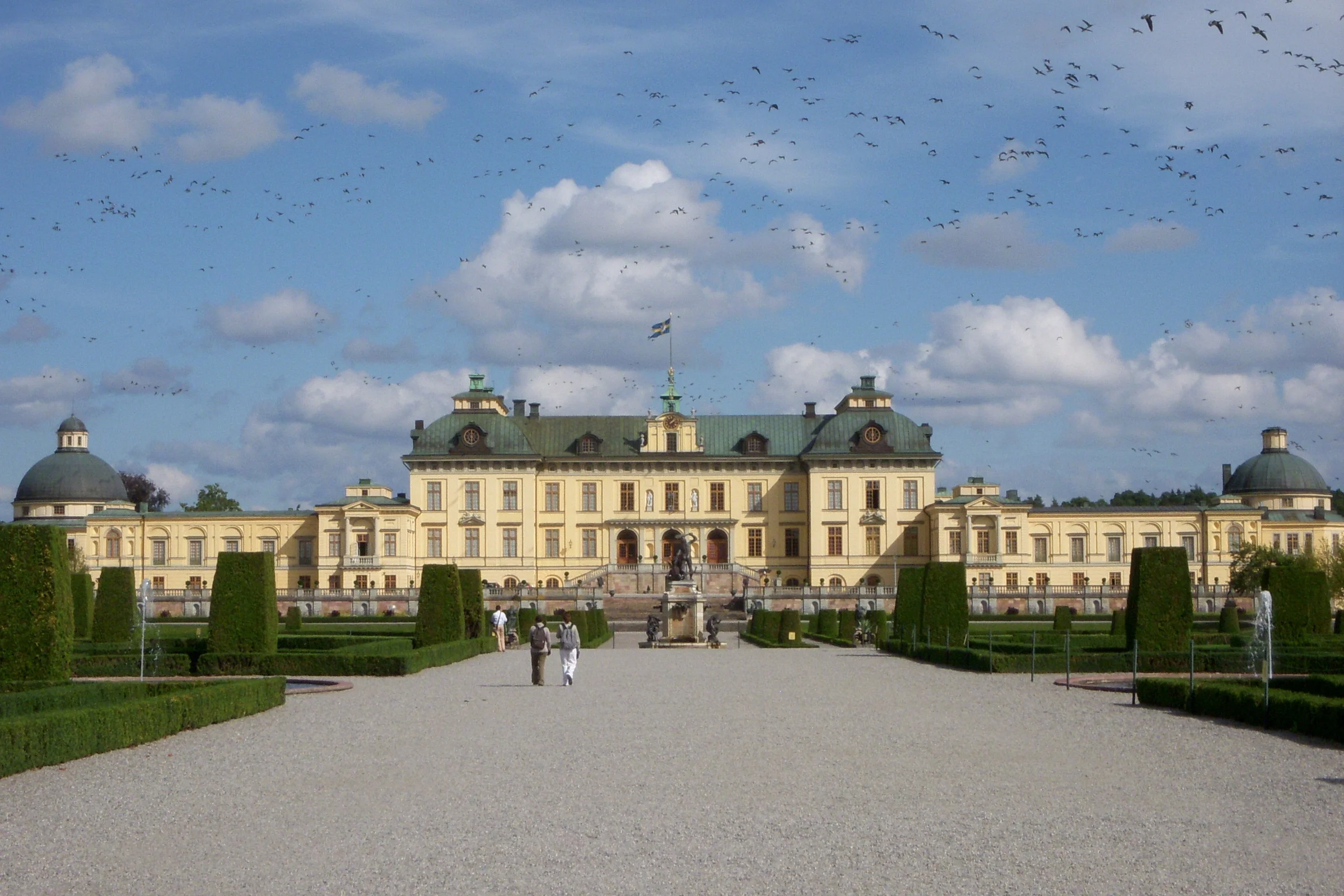
The palace as we know it was the project of Hedvig Eleonora, the dowager queen who held Drottningholm in the years after the 1661 fire. Widowed young, she was one of the most influential figures in Sweden during the later seventeenth century, a patron of building and the arts on a scale few could match, and she wanted a residence worthy of her standing. Rather than patch up what had been lost, she commissioned an entirely new palace and gave the work to Nicodemus Tessin the Elder, the leading Swedish architect of the age. Building began in 1662. Tessin the Elder designed a long, symmetrical Baroque palace, its central block flanked by wings and crowned with a distinctive silhouette, set on a terrace above formal gardens that were themselves conceived as part of the composition. The style looked to France and Italy, to the great continental palaces then defining what a royal seat should be, and it announced that Sweden, newly a European power, could build in that language too. Tessin the Elder did not live to see it finished; he died in 1682, with the palace well advanced but incomplete. The task passed to his son, Nicodemus Tessin the Younger, who had trained abroad and carried the work through to completion, refining the interiors and the setting with the confidence of an architect who would go on to shape royal building across Sweden. Between the two Tessins, father and son, the essential Drottningholm was made: the massive corps de logis, the ceremonial rooms, the grand staircase rising through the heart of the building, and the disciplined Baroque gardens stepping down toward the water. It is this seventeenth-century core, commissioned by a queen and drawn by two generations of one architectural family, that gives the palace its enduring shape.
A Rococo Transformation
A palace this large is never truly finished, and Drottningholm's second great chapter belongs to the eighteenth century. In 1744 the estate passed to a new royal owner: it was given as a wedding present to Princess Lovisa Ulrika of Prussia on her marriage to the Swedish heir apparent, Adolf Fredrik, and she set about remaking its interiors in the lighter, more intimate taste of her own generation. Where the Tessins had worked in the grand Baroque idiom of ceremony and display, the mid-eighteenth-century court preferred Rococo: pale colours, gilded ornament, mirrors, delicate stucco and rooms designed as much for conversation and private pleasure as for state occasions. Under her patronage several of the palace's most admired spaces took the form visitors see today. She was a serious collector and reader, and the library she created at Drottningholm reflected the intellectual ambitions of an Enlightenment court, a room meant for learning as well as for showing that learning off. Other apartments were redecorated and refurnished, so that walking through the palace became a walk through changing fashions, from seventeenth-century grandeur into eighteenth-century refinement. This layering is central to Drottningholm's character. The building was not frozen at completion and then merely maintained; it was lived in and continually adjusted by successive royal owners, each leaving rooms in the style of their moment. That is why the state apartments read as a sequence of periods rather than a single date, the Baroque bones of the Tessins dressed, in places, in Rococo clothing. The same royal household that reshaped the interiors also turned its energy on the park, and it is here, in the grounds beyond the formal garden, that the eighteenth century left Drottningholm its two most celebrated additions.
The Chinese Pavilion
The most enchanting of those additions is the Chinese Pavilion, known in Swedish as Kina slott, a small pleasure palace set apart in the park. It belongs to the great eighteenth-century European fascination with China, a fashion in which courts across the continent built rooms and garden buildings evoking an East they knew mostly through imported porcelain, lacquer, silk and travellers' tales. The present pavilion was built in the 1760s, a permanent structure replacing an earlier, slighter garden building that had stood on roughly the same spot. It is not Chinese architecture in any literal sense; it is a European vision of China, a chinoiserie fantasy in which Rococo forms and colours are dressed in exotic detail. Inside, the small scale is part of the charm. The rooms were made for retreat and delight rather than state ceremony, and they were filled with the lacquered furniture, painted panels and imported curiosities that made such interiors so prized. Set at the end of an avenue through the park, approached on foot and half-hidden by greenery, the pavilion was designed to be discovered, a surprise in the landscape rather than a monument on an axis. For visitors today it remains one of the finest surviving examples of its kind in Europe, and one of the reasons Drottningholm's grounds reward slow exploration. One practical note worth knowing before you plan a trip: the Chinese Pavilion is seasonal, opening in the warmer months only, while the park around it stays free to walk year-round. A combined ticket that takes in both the palace and the pavilion is the way to see the eighteenth century whole, the formal state rooms and the intimate garden retreat that the same court created within a few decades of each other.
The Court Theatre
The second great eighteenth-century addition to the grounds is the Court Theatre, Drottningholms Slottsteater, one of the most remarkable survivals of its kind anywhere. Built in the 1760s during the same burst of court activity that gave the park its pavilion, it was a working theatre for a court that took performance seriously, and Drottningholm became a centre of Swedish theatrical and musical life. What makes it extraordinary is not scale but survival. After its heyday the theatre fell quiet for long stretches, and that neglect, paradoxically, preserved it. When interest revived, it was found with its original eighteenth-century stage machinery largely intact, the hand-worked wooden apparatus of ropes, drums and painted flats that could change a scene in seconds and conjure waves, clouds and sudden transformations. Much of that machinery is still in use, which means audiences can see baroque stagecraft performed as it was meant to be, with the very equipment for which the plays and operas of the age were designed. Few theatres in the world offer that continuity; most surviving historic playhouses have long since been modernised behind the proscenium. A point of clarity for anyone planning a visit: the Court Theatre is run as a separate concern, with its own guided tours and its own performances sold through its own channels. It is not part of a palace ticket, and we do not arrange theatre seats or tour places. We mention it here because no honest history of Drottningholm could leave it out, and because standing in the park between the palace, the pavilion and the theatre is the best way to grasp how complete a royal world the eighteenth century built on this island. Treat it as something to see and to look into separately, a companion to your palace visit rather than a part of it.
A Stage for Court Life Across the Centuries
For all its beauty as architecture, Drottningholm has always been more than a monument; it was a working royal residence, and its rooms were built to be used. Across the centuries the palace served as a summer seat and a stage for court life, a place where the household moved out from the capital to live, entertain and govern against a setting designed to impress. The Baroque state apartments were not museum pieces when they were made but the machinery of ceremony: rooms arranged in sequence so that a visitor's progress toward the presence of royalty was itself a piece of theatre, each threshold marking a rise in privilege. The grand staircase, the painted galleries celebrating royal achievement, the state bedchamber with its layered decoration, all of these were instruments of a court that ruled partly through display. In the eighteenth century, as the interiors softened into Rococo and the park filled with its pavilion and theatre, court life at Drottningholm acquired a lighter, more cultivated character, closer to the Enlightenment ideal of a court that was learned and artistic as well as powerful. Music, theatre, reading, gardens and conversation became part of the palace's daily rhythm. What is striking, looking back, is the continuity. Unlike many royal houses that were abandoned, gutted by fire or swept away by revolution, Drottningholm was used and cared for generation after generation, its rooms adapted rather than discarded. That unbroken habitation is why the palace preserves so much, and why walking through it feels less like visiting a ruin than like passing through a house that different centuries have furnished in turn and then, quietly, kept.
World Heritage and a Living Palace Today
That continuity earned Drottningholm the recognition it holds today. In 1991 the palace, together with its park, its Chinese Pavilion and its Court Theatre, was inscribed on UNESCO's World Heritage List, becoming the first site in Sweden to receive that status. The listing recognises Drottningholm as the best-preserved royal palace of its era in Sweden and one of the finest expressions in northern Europe of the kind of royal residence, palace, garden and pavilions conceived as a single whole, that the seventeenth and eighteenth centuries produced. The distinction is earned less by any single masterpiece than by completeness: the Baroque and Rococo interiors, the formal garden and English landscape park, the chinoiserie retreat and the theatre with its working machinery all survive together, close to how successive courts left them. Drottningholm remains a royal residence to this day. Part of the palace is a private home, closed to the public, while the state rooms, the park and the pavilions are open to visitors, a balance that lets the building stay alive rather than becoming a preserved shell. For the traveller, that living quality is the whole point. You are not walking through a reconstruction but through the real, layered fabric of a palace that has been continuously inhabited for more than three hundred years. A visit today centres on the Baroque and Rococo state rooms, with the seasonal Chinese Pavilion adding the eighteenth century's most delightful flourish and the free park inviting a longer, slower afternoon. Admission is valid all day on your chosen date, and the palace keeps a short winter calendar, so it is worth fixing your date before you travel and letting the history do the rest once you are through the door.
Frequently asked
Why is Drottningholm called "Queen's Island"?
The Swedish name Drottningholm means "Queen's Island". It dates from the late 16th century, when King Johan III built the first palace on the island of Lovön for his consort, Queen Katarina Jagellonika. The name stayed with the site after that palace burned down on 30 December 1661.
Who built Drottningholm Palace?
The dowager queen Hedvig Eleonora commissioned the palace after the 1661 fire. She hired the architect Nicodemus Tessin the Elder, who began work in 1662. After his death in 1682 his son, Nicodemus Tessin the Younger, completed the building. Later royal owners added the Rococo interiors, the Chinese Pavilion and the theatre.
How old is the Chinese Pavilion?
The present Chinese Pavilion, or Kina slott, was built in the 1760s, replacing an earlier garden building on roughly the same spot. It is a European vision of China in the Rococo taste rather than literal Chinese architecture. It opens seasonally in the warmer months, while the surrounding park stays free to walk year-round.
Is Drottningholm a UNESCO World Heritage Site?
Yes. Drottningholm, with its palace, park, Chinese Pavilion and Court Theatre, was inscribed on the UNESCO World Heritage List in 1991, becoming Sweden's first World Heritage Site. It is recognised as the best-preserved Swedish royal palace of its era and a complete example of a royal residence conceived as a single ensemble.
Is the palace still lived in?
Yes. Drottningholm remains a royal residence. Part of the palace is a private home closed to the public, while the state rooms, the park and the pavilions are open to visitors. That continuous use is a large part of why the palace and its interiors are so exceptionally well preserved today.